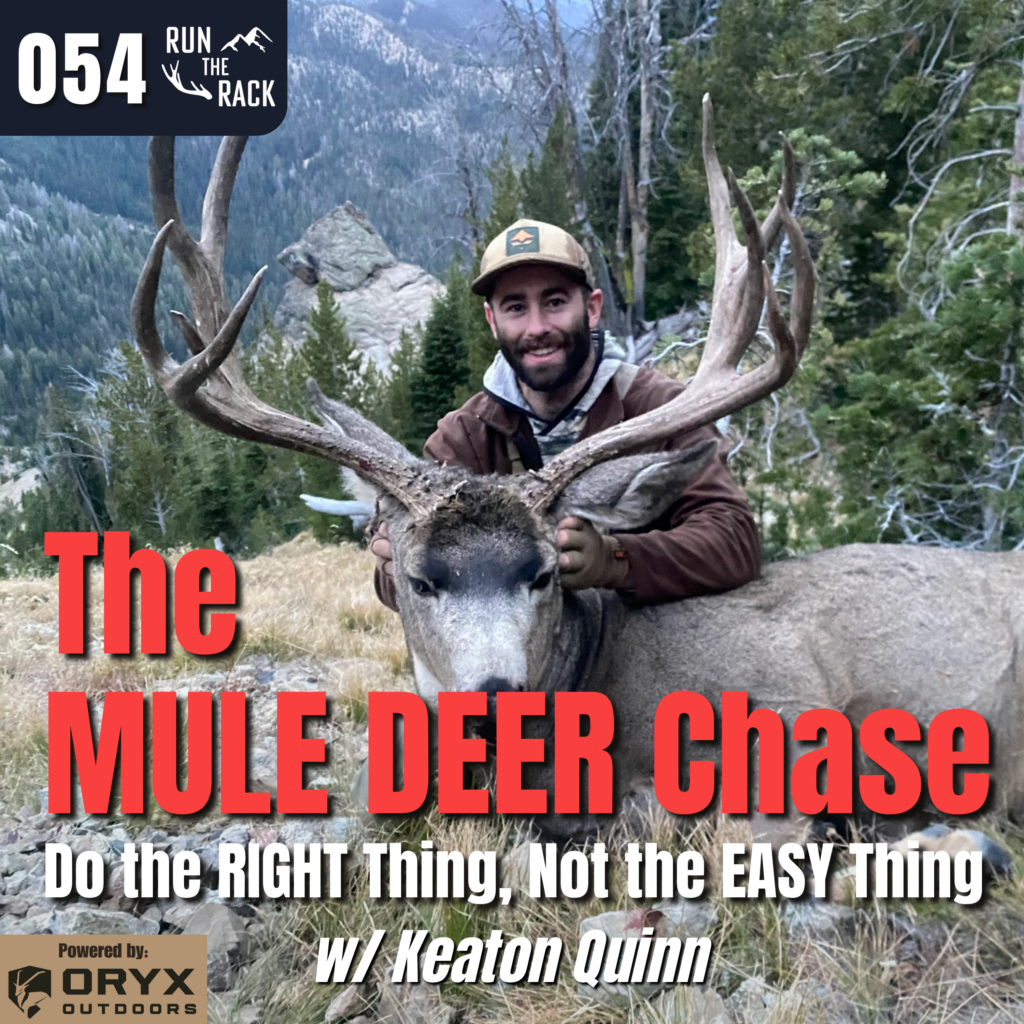
Keaton Quinn sits down with Weston Homa to discuss his journey as a backcountry hunter.
Listen in for Keaton’s insights in his pursuit of his 198-inch buck proving that patience, knowledge, and grit can turn luck into legendary success.
In this episode, Keaton shares the gritty details of chasing, recognizing, and ultimately killing one of the biggest bucks he’s ever laid hands on — all while revealing the critical lessons learned along the way that can help any hunter level up.
Timestamps:
00:00 – Introduction: Keaton Quinn’s background and recent hunts 02:02 – How Keaton’s journey chasing mule deer evolved over the years 03:25 – Early experiences and shot at his first bucks in Idaho 05:18 – Obsessions with mule deer migration, understanding behavior, and the importance of patience 07:16 – Learning from failures and the importance of research and calling biologists 09:42 – Recognizing the value of humility and continuous learning in hunting 11:37 – The story of Keaton’s biggest buck at 198 inches – a detailed chase 15:03 – Scouting methods: using Google Maps and terrain features for planning hunts 18:25 – The sacrifice and patience involved in high country mountain hunts 20:24 – The importance of locating bucks pre-season and the challenges of terrain 24:12 – Using glassing techniques and equipment choices at long distances 27:34 – The strategy of stalking and the role of patience in mountain approaches 30:00 – The critical moments of re-locating the buck and moving efficiently 36:16 – Staying calm and making measured shots in steep, unpredictable country 43:16 – The mental discipline of waiting, trusting your instincts, and handling pressure 57:36 – The significance of perseverance and decision-making during the final shot 63:14 – Training, marathon running, and pushing physical limits for mountain hunts 67:06 – Enduring hardship, cramping, and physical fatigue in marathon and mountain days 70:32 – Applying lessons from endurance sports to hunting and the mindset of a hunter 74:06 – The story of Full Frame outdoors: innovations in digiscoping and rifle accessories 76:28 – Developing gear that enhances performance without breaking the bank 78:56 – Connecting with Keaton’s platforms and his future hunts 79:26 – Wrapping up: plans for spring bears, shared excitement, and gratitude
Partners:
Oryx Outdoors – Fitness apparel for those who are driven to push boundaries—whether that means improving their gains at the gym or filling their freezers. Use code WESTON for 10% off your next order! – https://tinyurl.com/yeay296d
Takeaways:
- Top performance comes from mental discipline and trust in the process
Success, especially in high-stakes pursuits like hunting or endurance sports, hinges on the ability to regulate your mind to remain patient and rational under pressure. Adopting a mental model focused on patience and trusting your decision-making process dramatically increases your chances of success and reduces costly mistakes. Keaton’s story of waiting four hours for the right shot exemplifies how resisting impulse and relying on experience even in stressful moments can lead to game-changing outcomes. - Hidden leverage in patience is overlooked—small decisions compound
Most hunters and high performers underestimate how small, disciplined choices—like delaying a shot or waiting for better conditions—add up to create a significant advantage over instinctive reactions. Recognizing the value of incremental discipline shifts your approach from reactive to strategic, extending your capacity for success in any complex environment. Keaton’s long wait for the perfect shot, despite immediate opportunities, underscores how patience and decision timing often are the difference between success and failure. - Mastery requires embracing the discomfort of growth
Getting to the next level in any pursuit involves a ‘valley of despair,’ where humility replaces overconfidence, and learning is reinforced through adversity. Understanding this mental model allows you to reframe setbacks as vital progress markers, fostering resilience and continuous improvement. Keaton’s evolution from a novice to a seasoned hunter illustrates how persistent learning through failures catalyzes advanced skill acquisition. - Prioritizing mental toughness through deliberate suffering trains resilience
Intentionally facing hardship—like running in adverse weather or pushing through fatigue—builds mental fortitude transferable to high-pressure scenarios. The capacity to endure discomfort without losing focus enables greater consistency and performance in demanding situations. Keaton’s training in extreme environments exemplifies how embracing discomfort in non-critical moments enhances readiness for critical outcomes. - Systems thinking applied to scouting and decision-making enhances success
Effective hunting or project execution involves understanding and leveraging the environment—be it terrain, animal patterns, or market dynamics—through strategic observation and adaptation. This mental model promotes proactive planning and situational awareness, reducing risks associated with impulsive actions. Keaton’s strategic scouting and use of tools like Google Maps and glassing exemplify environmental awareness as central to guaranteed success. - Confidence stems from accumulated experience, not certainty
True confidence in complex tasks arises from a history of making good decisions under uncertainty, acknowledging that failure is part of the learning process. Shifting focus from needing absolute certainty to trusting your experience lowers the fear of failure and encourages taking calculated risks. Keaton’s humility after setbacks and reflection on lessons learned foster a growth mindset that enhances future decision-making. - Simplification and focus enhance effectiveness over complexity
Elegant tools and strategies—like simple gear setups or basic mental frameworks—often outperform overly complicated systems because they are more reliable and easier to execute. Adopting minimal yet effective solutions frees mental bandwidth, allowing sharper focus on critical decisions that matter. Keaton’s preference for straightforward gear and deliberate decision-making exemplifies how minimalism in approach yields more consistent results.